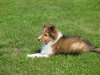
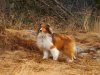
What color will he be?

So what colour is he now? This post if over a year old but recently resurrected, so now I'm curious.

When I looked back at the pictures I saw some red sable that i missed before (how I could, since I've got one myself, I dunno) These puppy pictures look very much like my Bacca. He ended up with mostly red, but subtle overlays of dark hair.
 
Meant to post a photo of Bacca then and now...
 

Attachments

  • IMG_0003.jpg
    IMG_0003.jpg
    74.5 KB · Views: 50
  • P7197521-2.jpg
    P7197521-2.jpg
    70.2 KB · Views: 56
Well, thanks! I was really only showing the pictures to show how colours can change from puppy to adult.

But I have to agree....this is one of my favourite pictures of Bacca....doing his Lion King act!

(His other look is "Eeyore". I won't post it, but I think I've got his Eeeyore pictures in my photo albulm)

Ok....sorry....back to the thread....
 
Barb, Bacca is a pure-for-sable, not a "shaded", "mahogany", or (correct term), "Tri-factored sable". A tri-factored sable can be a bi-factored sable.
That is usually seen as a smutty color, not bright, and sometimes raccoon eyes. The clear black overcoat on a sable with no dull grey undertone, is thought to be tri-factored only. Looking at the pedigree, can also give you the clues you seek.
 
Barb, Bacca is a pure-for-sable, not a "shaded", "mahogany", or (correct term), "Tri-factored sable". A tri-factored sable can be a bi-factored sable.
That is usually seen as a smutty color, not bright, and sometimes raccoon eyes. The clear black overcoat on a sable with no dull grey undertone, is thought to be tri-factored only. Looking at the pedigree, can also give you the clues you seek.


I know that now....but when Bacca was a pup, he had alot of dark hair that overshadowed his true colour.

My point was only that its difficult to know until they get to a certain age.

Finally, I guess, I would say not to be anal about it....because you can't change it....It's gonna be what its gonna be! :winkgrin:
 
And all the colors are so unique and wonderful ... that's one of the many, many things I love about Shelties.
 
Barb, Bacca is a pure-for-sable, not a "shaded", "mahogany", or (correct term), "Tri-factored sable". A tri-factored sable can be a bi-factored sable.
That is usually seen as a smutty color, not bright, and sometimes raccoon eyes. The clear black overcoat on a sable with no dull grey undertone, is thought to be tri-factored only. Looking at the pedigree, can also give you the clues you seek.


As an additional note... most folk don't know what pure for sable, shaded, tri-factored sables.

And what do you mean about smutty color...(are you referring to Bacca here? :confused2: Eeek!)

Terminology like clear black overcoat, etc. is not especially helpful to us lay-folk

Can you put this into different terms?
 
When the dog is bi-factored, the color looks black-ish grey. There is usually a black-ish color to their face, instead of the rich tan on a sable or even tri-color. That is what I mean by racoon eyes. The hint of black goes down the muzzle and sometimes around the eyes.
It is easier to see it on a bi-factored sable. The bi gene is recessive and must couple with another bi gene to be expressed. A bi-color dog must have two bi genes.
Here is an example of how far reaching it can go:

A tri-factored sable bred to a bi-factored tri-color can produce=
tri-factored sable, bi-factored sable, tri-color, and bi-factored tri-color.

A tri-factored sable bred to a bi-factored sable can produce=
pure-for-sable,tri-factored sable,bi-factored sable,and a bi-factored tri-color

I am certainly not an expert on all the combinations, and to help me with this illustration, I referred to The Color Inheritance Charts.
 
Back
Top